Tupelo Press · 2021
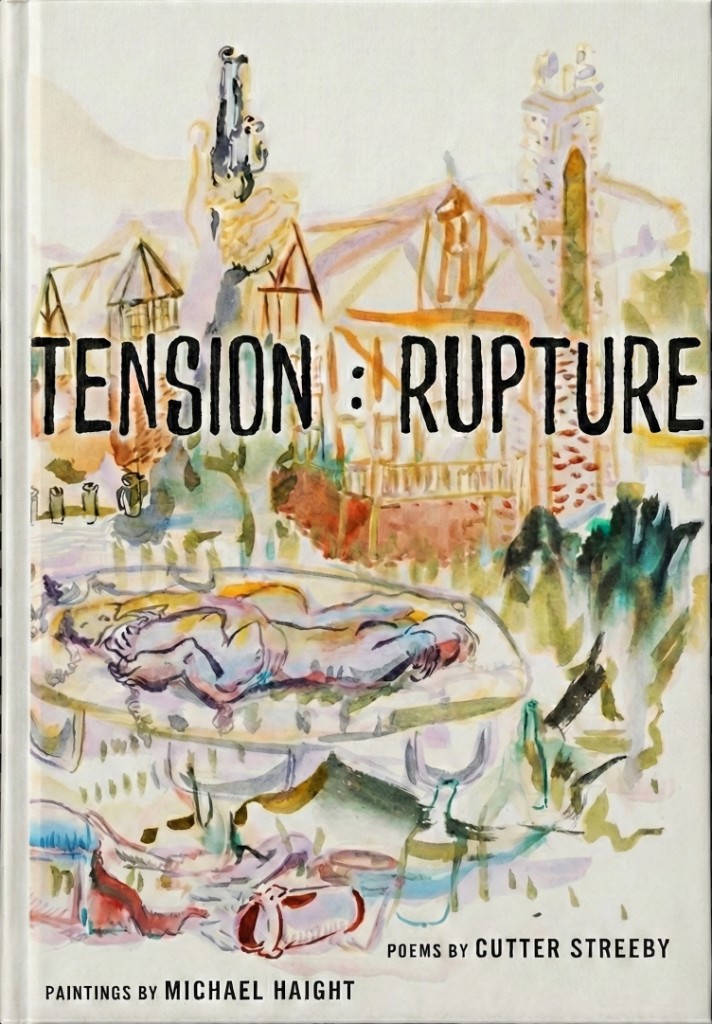
Tension : Rupture
A reversible ekphrasis collaboration where poetry and painting translate one another
4.78 (69 ratings)
About the Work
Tension : Rupture takes its root from ekphrasis—the classical traffic from image to text—and from the canonical modern staging of that traffic in Keats's "Ode on a Grecian Urn." But the book begins where that tradition typically stops. Ekphrasis is usually a one-way address: a poem speaks about an artwork, and the artwork remains inert, unanswering. Keats's urn "speaks" only because the poem ventriloquizes it; the object's silence is the condition that allows the lyric to claim interpretive authority.
This project breaks that asymmetry by making ekphrasis reversible and auditable. Haight translates my poems into paintings, and I translate his paintings into poems. Each work is not merely about the other; each is a materially new work produced under declared constraints, with directionality named as part of the method: poem → painting and painting → poem. The book insists that translation is not a solitary interpretive flourish but a relay of constrained decisions in which responsibility can be traced: what the source piece forces, what it permits, and what it refuses.
The "echo" of a source here is not stable content carried across media; it is drift—formal pressures that reappear under different affordances. A painting cannot "preserve" syntax, and a poem cannot "preserve" pigment, so the book foregrounds what ekphrasis often hides: that intersemiotic translation produces ontologically new objects whose accountability is structural rather than representational. Tension : Rupture therefore treats the ekphrastic lineage not as a precedent to emulate, but as a problem to reopen: what changes when the artwork answers back, and when the poem must become, in turn, a source that can be translated.
Praise
More on Goodreads →“Tension : Rupture is a brilliant shapeshifting book that repurposes the ekphrasis as a mode of enquiry. Cutter Streeby's engagement with Michael Haight's ephemeral works, Alcoholic Crepuscules, offers us vivid painterly poems often laced with the surreal. There's an alchemy of sorts, a reaching into and melding into Haight's de-stabilizing work. Both artists operate in a zone of intensity that offers a reader different levels of immersion and experience.”

Mona Arshi
Poet & Author
“Isolated from my friends due to the global pandemic, I'm ravenous for good conversations. Tension : Rupture arrived just in time. The conversation between Michael Haight and Cutter Streeby is enthralling, bright with human excess and intimacies. Streeby's poems trouble into speech the tender and volatile flesh in Haight's art, and the color in Haight's art is lyrical, transcendent. Each painting, each poem filled 'my living room with burning stars.'”

Eduardo Corral
Poet
“In Tension : Rupture, Cutter Streeby navigates desire and poesis with language as a taut and slippery lifeline in poems complemented and complicated by Michael Haight's hallucinatory vignettes veering from bacchanal to disaster and back again. Though tonally elegiac, Streeby's poems trouble easy divisions between past and present, asking what memories still keep making us in their wakes and our awakenings. Streeby traverses time and tongues, eschewing a monolithic origin story and crafting a dazzling mosaic of originary moments instead.”

Dora Malech
Poet & Professor
“Ekphrasis has many faces. Re-enactments in one medium of a work in another can grow tedious. The true process involves touching base, understanding that base, then dancing down a course beginning in that understanding. That is the course followed by the collaboration between artist Michael Haight and poet Cutter Streeby... It makes for an exciting set of collisions as much as collaborations. There are doors constantly opening onto potentially fierce landscapes the reader senses before being propelled onward.”

George Szirtes
Poet & Translator
“In this beautiful collaboration Tension : Rupture the bright architectures of bodies are ablaze on both canvas and page. Haight's vibrant colors complement the energy of Streeby's lines, and the union confronts the rending of intimacy with a rendering of it. Here among the heliotropes and blood halos, 'language is a conspiracy between two people.' Figure and syllabary create a dialogue across this book, giving a name to each feeling and a voice to every fire.”

Traci Brimhall
Poet
“I'm making textual interventions in these praise blocks—do they count as intersemiotic translation? Where do the edges of the practice fall? By shifting the hue, I keep categorical contrast while refusing UI semantics: it reads as emphasis, not clickability. That was the aim—foreignization by pigmentation, not the kind of UI destabilization I use on my Translator's Stance page. The artists' praise remains verbatim, yet the result is debatable because attention gets reweighted. But if textual weight and color shift, does the original meaning shift with them?”

Cutter Streeby
Poet & Translator
Press
"At each exchange, there is an intersection, a tension, a rupture between our languages and our memories,"
Soules sets the scene in process: during the pandemic, Streeby invited Haight to respond to poems from an "open to changes" manuscript, and the dialogue kept going past a standard ekphrastic stopping point. From there, she lays out the steps—Haight's "Alcoholic Crepuscles," Streeby's new poems, Haight's selected "details," and Streeby's answering "details"—until the book reads as a captured moment inside an ongoing conversation. She closes by positioning the reader as the third point in the circuit: entering the book means joining the exchange.
ReviewMatter Monthly — Aline Soules, 2022"Ekphrasis feels like plastic. It's an open and nebulous, shape-shifting thing."
Troy opens the conversation by expanding what ekphrasis can do: not illustration, but translation "across any medium." From there, Streeby and Haight describe a relay process where agency keeps moving—poems becoming paintings, paintings returning as "detail shots," and those details turning back into poems. As the exchange intensifies, even page design becomes part of the method: placing poem and image on facing pages "sets the mood," making tone and form a joint decision.
FeatureTupelo Quarterly — Tiffany Troy, 2022"The works in the publication serve as artifacts of Streeby's and Haight's highly interactive process."
Faller invites the reader to approach the book as evidence of making—not a finished "pairing," but the trace left by a long collaboration. He describes the poems and images as "artifacts" and "breadcrumbs," emphasizing that Haight's paintings are "about" the poems without serving as illustrations. By the end of the review, the roles have flipped and blurred—text can behave illustratively, and images can carry narrative weight—so the reader watches exchange do the book's structural work.
ReviewTupelo Quarterly — Bryan Faller, 2021"It is the space around the colon that charges the moment... Time elasticates."
Cory begins with the title itself, treating "Tension : Rupture" as a miniature version of the book's drama. From there, she shows how punctuation and white space become timing devices: the colon propels, the gap interrupts, and suspense gathers in the interval—"between the action of undoing and the undoing itself." That staging pushes the reader into the work's liminal zone, where participation becomes part of how the book performs.
ReviewThe Lit Pub — Cynie Cory"it sort of became a blended, inter-semiotic translation of our art forms."
Fujimoto's interview sets the question of coherence on the table—what holds a collaborative, autobiographical book together? Streeby answers by shifting the terms: the project began in a traditional "illustrative" mode, but evolved into "a blended, inter-semiotic translation of our art forms." Instead of protecting a single narrative line, the collaboration follows memory and artistic response as the governing signals.
InterviewRHINO Poetry — Naoko Fujimoto, 2022"I've been searching for contemporary work like this for a while now"
Harryman eases you in with a scene—reading the book mid-flight—and then pivots to what the opening poem establishes: making as pressure, and art as response. From there, she tracks how poems and paintings keep discovery alive, with "details" that "bleed into other depictions" rather than locking into a single, contained narrative. The effect is cumulative: revisiting isn't optional—it's how the work keeps opening.
ReviewFive South — K.D. Harryman, 2021"In his medium of poetry, Streeby still at times seeks to work as a painter, so it makes sense to endeavor such a collaboration..."
Desimone starts from the book's prologue and names the stakes of collaboration across media: two artists working through interrelated autobiographical material, with addiction as a shared pressure point. He then reframes the title as method—"the dual process"—where dialogue "dictat[es]" new paths, doorways, and dead ends as the work develops. What keeps that method ethical, in his reading, is friendship: a commitment to guiding one another through darkness while resisting a savior posture.
ReviewHeavy Feather Review — Arturo Desimone, 2021"It became like a reverb chamber where we would bounce ideas off each other and this synergy formed."
Morehead's interview begins at the turning point: the project started as traditional ekphrasis, but then Streeby began changing the poems to fit the paintings, and the collaboration became "a reverb chamber." From there, the conversation moves into technique—why the block form, and how the colons function—so the reader can see craft decisions as part of translation, not ornament. The result is a clear picture of form as a tool for keeping rhythm, voice, and exchange legible on the page.
InterviewViewless Wings — James Morehead, 2022"the conversation between Michael Haight and Cutter Streeby is enthralling, bright with human excess and intimacies."
Award ListingCLMP — 2021